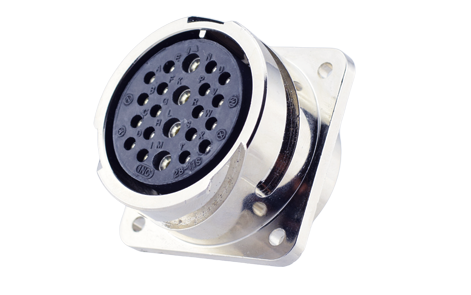
Amerline offers quick-disconnect coupling solutions built for the demands of military and industrial applications, from our stock connector series to fully custom configurations. With 40+ years of experience supporting defense and industrial connector needs, Amerline helps engineers and procurement teams identify the right solution for their application, whether that's an off-the-shelf solution or a modified design that meets specific environmental, mechanical, or cycle life requirements.
Quick-Disconnect Coupling
Quick-disconnect couplings are built for applications where reliable electrical connections need to be installed fast, held securely, and released just as easily.
What Is Quick-Disconnect Coupling?
In defense and industrial applications, connection speed and reliability are both mission-critical. Quick-disconnect military connectors are specialized electrical couplings engineered to mate and unmate rapidly without any tools and under the most demanding conditions.
A quick-disconnect connector is either fully mated or it isn't. That eliminates torque as a variable entirely, a meaningful benefit when you're working in the field and consistency matters most.
Note: The terms quick coupling and quick coupler are often used interchangeably with quick-disconnect coupling, particularly across industrial and manufacturing contexts. In electrical connector applications, all three refer to a connector designed for fast, tool-free mating and unmating.
How Quick-Disconnect Coupling Works
Quick-disconnect couplings achieve secure mating through a partial-rotation locking mechanism. When the connector is aligned and engaged, a short rotational motion — typically a half-turn — seats the locking mechanism and confirms full mating. Depending on the design, this is communicated through an audible click or tactile feedback, giving the operator immediate confirmation without the need for visual inspection or torque measurement.
This mechanism allows for fast, repeatable connections across service cycles. It's what makes quick-disconnect couplings especially well-suited to applications where connectors are frequently mated and unmated, or where speed of assembly directly affects system uptime.
Bayonet vs. Reverse Bayonet Quick Coupling
Both bayonet and reverse bayonet connectors use a partial-rotation engagement principle to rapidly connect, but they differ in which component moves during the locking sequence.
With a standard bayonet connector, the connector body rotates to engage the locking pins. In a reverse bayonet design, the connector body remains stationary while an outer sleeve or collar rotates to secure the connection. This distinction matters in applications where vibration, restricted access, or the risk of inadvertent disconnection is a concern.
Because the mating interface doesn't rotate, a reverse bayonet connector maintains a more stable contact alignment throughout the engagement process that reduces wear and improves reliability in high-vibration environments.
Both types offer the same fundamental benefit: a tool-free, single-motion connection that confirms full engagement without ambiguity.
Quick-Disconnect Couplers vs. Threaded Fittings
Quick-disconnect couplings — bayonet and reverse bayonet alike — are purpose-built for fast engagement. A half-turn is all it takes to fully mate or release the connection, and the tactile or audible confirmation removes guesswork from the process.
Threaded connectors take a different approach. Multiple turns are required to fully seat and secure the connection, and operators must apply careful torque control to avoid under- or over-tightening. While this adds time and requires more attention during assembly, some industries favor threaded mechanisms specifically for the added mechanical resistance they provide at the connection point.
Neither design is superior; the right choice depends on the operational demands of the application.
Functionality in Practice: Where Quick-Disconnect Couplings Are Used
Defense and Military Systems
In defense applications, a connector that fails in the field is a liability. Quick-disconnect couplings give maintenance personnel the ability to swap components rapidly without specialized tools, keeping systems operational under pressure. Their binary mating confirmation also removes uncertainty from the process, which matters when there's no room for error.
Aerospace Platforms
Aerospace environments place unique demands on connector hardware, with vibration, thermal cycling, and weight all factoring into design decisions. Quick-disconnect couplings offer a reliable mating mechanism that holds secure under persistent vibration without adding unnecessary bulk or complexity. Their ease of service is also an advantage during ground maintenance, where turnaround time directly affects operational readiness.
Automation and Industrial Equipment
In automated manufacturing and industrial settings, connectors are mated and unmated far more frequently than in static installations, and downtime for connector service adds up quickly. Quick-disconnect designs reduce the time and attention required for each service cycle, supporting faster maintenance without sacrificing durable connection integrity. For facilities running continuous operations, that efficiency translates directly to productivity.
Transportation Systems
Ground vehicles and rail platforms expose connector hardware to persistent vibration, temperature swings, and physical abuse that accelerate wear in standard designs. Quick-disconnect couplings built to military ruggedization standards are well-suited to these environments, maintaining secure connections even as operating conditions change. Their serviceability also simplifies maintenance for vehicle fleets where connectors may need to be accessed repeatedly over a long service life.
Sensors and Precision Measurement Equipment
In sensing and measurement applications, connection quality directly affects the accuracy and consistency of the data being captured. Quick-disconnect couplings provide a stable, repeatable mating interface that minimizes variability at the connection point. For equipment used in calibration, testing, or monitoring roles, that consistency is part of what makes the measurement trustworthy.
Frequently Asked Questions About Quick-Disconnect Coupling
How do you install a quick-disconnect coupling?
Installing a quick-disconnect coupling is straightforward by design. Align the connector keyways, push the mating halves together, and rotate the locking sleeve or body a half-turn until you feel or hear the engagement confirmation. No tools are required, and no torque spec needs to be met, which makes installation faster and more consistent compared to threaded alternatives, particularly in the field or in high-cycle industrial applications.
What makes a quick-disconnect coupling suitable for harsh environments?
Quick-disconnect couplings designed for military and industrial applications are built to perform where standard connectors fail. Ruggedized shell materials, environmental sealing, and locking mechanisms that resist vibration-induced backing-out all contribute to durability and reliable performance under mechanical stress and exposure.
What pressure rating should a quick-disconnect coupling have?
Pressure rating requirements for quick-disconnect couplings vary significantly depending on the application, operating environment, and system design. Consulting with a connector manufacturer and referencing the applicable standards for your application is the most reliable way to confirm a quick-disconnect coupling will perform to spec under expected pressure conditions.
Are military-style quick-disconnect couplings suitable for industrial applications?
Military-grade quick-disconnect couplings are well-suited to demanding industrial applications precisely because they're built to a higher standard than most commercial connector hardware. The ruggedization, environmental sealing, and cycle life requirements that make a quick coupler suitable for defense translate directly to performance advantages in industrial environments, particularly those involving heavy machinery, persistent vibration, chemical exposure, or extreme temperature variation.