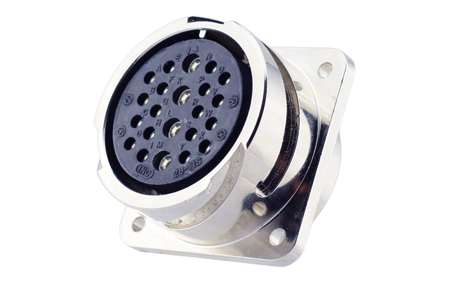
Amerline offers quick-disconnect coupling solutions built for the demands of military and industrial applications, from our stock connector series to fully custom configurations. With 40+ years of experience supporting defense and industrial connector needs, Amerline helps engineers and procurement teams identify the right solution for their application, whether that's an off-the-shelf solution or a modified design that meets specific environmental, mechanical, or cycle life requirements.
What Is Bayonet Coupling?
Key Takeaways
- The bayonet mechanism locks a plug and receptacle together with a single push-and-twist motion, typically about a third of a turn.
- An audible click, tactile resistance, and visual alignment marks confirm secure mating without needing a torque spec.
- Standard and reverse bayonet designs simply swap which half carries the pins versus the ramps, with reverse bayonet offering stronger vibration resistance.
- Compared to threaded coupling, the bayonet mechanism mates and releases faster and without tools, though threaded connectors handle higher loads.
- Connector selection between bayonet and threaded coupling should be based on the application's speed, vibration, and load requirements rather than one style being universally better.
Bayonet coupling locks a plug to a receptacle with a single push-and-twist motion. Radial pins on one half of the connector ride along L-shaped ramps on the other half and snap into locking detents, confirming a secure connection in about a third of a turn. Amerline builds this coupling system into products in our AEC connector series, pairing fast mating cycles with dependable performance.
How Does Bayonet Coupling Work?
Bayonet coupling converts rotational motion into axial force. A small number of pins travel along shaped ramps and lock into place, so the technician never has to thread a nut down over dozens of turns.
A handful of precision-machined parts work together to make this happen: the pins, the ring that carries them, and the detents that hold everything in place once mated. The sequence they follow during mating explains why the design holds up under demanding field conditions.
What Are the Physical Components of a Bayonet Coupling?
- Bayonet pins: Three equally spaced, hardened pins on the receptacle shell engage the ramped slots on the plug's coupling ring.
- Coupling ring (coupling nut): This free-spinning ring on the plug carries the L-shaped ramped channels that guide the pins. Rotating the ring is the only action needed to mate or unmate the connector.
- Locking detents: Each ramp ends in a recess where the pins seat once fully rotated. These recesses hold the connection secure under vibration and light axial load.
- Inspection holes: Small openings in the shell let technicians visually confirm the pins have fully seated in the detents, without disassembling the connector.
- Retention spring: This spring-loaded element keeps tension on the pins so the coupling resists loosening from vibration and holds its locked position.
How Does the Bayonet Mating Sequence Work?
- Align the key and keyway. Line up the plug and receptacle so the polarizing key drops into its keyway. This step ensures the pins enter the ramps in the correct orientation.
- Push to engage the pins. Push the plug straight into the receptacle until the pins enter the mouths of the ramped slots on the coupling ring.
- Rotate about one-third of a turn. Twist the coupling ring clockwise. The pins ride along the ramps and draw the connector faces together as they travel.
- Confirm the click. Listen for a distinct click, check visual marks for proper alignment, and note the change in resistance. Together, these signals confirm the pins have dropped into the locking detents and the connector has fully mated.
- Reverse to unmate. Rotate the coupling ring counter-clockwise to lift the pins back out of the detents and reverse the ramp travel. The connector releases in the same one-third turn.
This sequence describes standard bayonet coupling, like in Amerline’s 26482 Commercial Connector Series, where the pins sit on the receptacle and the ramps on the plug. Reverse bayonet coupling, like in Amerline’s 95234 Reverse Bayonet Connector Series, follows the same push-and-twist steps but swaps that arrangement — the pins move to the plug and the ramps to the receptacle — which increases resistance to accidental disconnection under vibration.
Threaded connectors reach a secure connection along a different path. The comparison below shows how the two approaches vary.
Bayonet Coupling Mechanism vs. Threaded Coupling: A Side-by-Side Look
|
Factor |
Bayonet |
Threaded |
|
Mating speed |
One push-and-twist motion completes the connection in seconds, about a half-turn. |
Full rotations, plus torque control, take more time. |
|
Mating confirmation |
An audible click plus tactile confirmation and visual cues confirm connection. |
A torque spec and feel confirm the connection rather than a click. |
|
Blind-mate capability |
The design mates reliably even without a clear line of sight. |
Operators can blind-mate a threaded connector, but judging engagement by feel takes skill. |
|
Vibration resistance |
The detent and, on reverse bayonet designs, the pin placement resist disconnection under vibration. |
Proper torque delivers strong vibration resistance; correct assembly matters more than with a bayonet. |
|
High-load or torque capacity |
The coupling handles moderate loads well. |
Clamping force scales with thread engagement, so the coupling handles high loads well. |
|
Tool requirement |
Technicians typically need no tools to mate or unmate the connector. |
Technicians often need a wrench, spanner, or torque tool. |
|
Typical standards |
VG95234 covers reverse bayonet coupling; MIL-DTL-26482 covers standard bayonet coupling. |
MIL-DTL-5015 and other threaded MIL-SPEC families cover threaded coupling. |
Threading adds time and requires more attention during assembly, but some industries favor threaded mechanisms specifically for the added mechanical resistance they provide at the connection point.
Meanwhile, bayonet connectors offer the advantage of blind mating in restricted spaces.
Neither design is superior. The right choice depends on an application’s operational demands.
At Amerline, we manufacture connectors in both styles, which lets engineers choose the coupling that fits the application without switching suppliers.
Where Is Bayonet Coupling Used?
Bayonet coupling shows up wherever connectors need to mate and release quickly without sacrificing a secure hold once locked. That speed and reliability spans both defense-driven and commercial or industrial settings.
What Military and Defense Applications Use Bayonet Coupling?
Military and defense equipment routinely face mechanical shock, sustained vibration, and field conditions where a technician may need to disconnect and reconnect a cable in seconds, often while wearing gloves. Bayonet coupling, and reverse bayonet coupling in particular, meets that combination of speed and ruggedness.
This includes:
- Ground vehicles: Power and signal connections withstand continuous road vibration and rough handling during maintenance.
- Naval systems: Shipboard electronics endure constant mechanical vibration in tight equipment spaces.
- Airborne electronics: Avionics and onboard systems demand low weight, vibration resistance, and connector reliability all at once.
- Field communications: Radios and comms equipment need to connect and disconnect quickly during setup, teardown, or repositioning.
What Commercial and Industrial Applications Use Bayonet Coupling?
Outside of defense, bayonet coupling earns its place anywhere equipment vibrates, undergoes frequent servicing, or simply needs a faster connection than threading a nut down by hand.
This includes:
- Welding equipment: Technicians frequently disconnect these connectors for equipment changeovers and rough handling on a shop floor.
- Industrial automation and sensors: Compact bayonet connectors link sensors and control equipment where signal integrity and a small footprint both matter.
- Medical devices: Staff mate and release this equipment reliably, often under time pressure, without extra tools.
- Commercial aircraft: Interior and system wiring calls for both vibration resistance and quick servicing.
Coupling mechanism and environmental protection are separate design decisions. It's worth understanding how bayonet coupling pairs with environmentally sealed connectors in applications exposed to moisture, dust, or temperature extremes.
Frequently Asked Questions About Bayonet Connectors
What does bayonet coupling mean?
Bayonet coupling is a connector locking mechanism that uses pins and matching slots instead of screw threads. A quick push-and-twist, typically about a third of a turn, seats the pins in locking detents and completes the connection. Bayonet couplings are designed for rapid assembly and disassembly.
What is the difference between bayonet connectors and reverse bayonet connectors?
Standard bayonet coupling places the locking pins on the receptacle, with the ramps on the plug's coupling ring. Reverse bayonet coupling moves the pins to the plug and the ramps to the receptacle instead. That switch increases resistance to accidental disconnection, which is why manufacturers favor reverse bayonet for high-vibration applications within the military and industrial environments.
How many degrees of rotation does a bayonet coupling require?
A bayonet coupling typically needs about 120 degrees of rotation, roughly a third of a turn, to fully lock. Threaded couplings often require several full rotations to seat and tighten completely.
Can bayonet connectors be used in outdoor and sealed environments?
Yes. The coupling mechanism and the environmental sealing are separate design features. Manufacturers can build bayonet connectors with face seals, wire seals, or grommet seals to handle moisture, dust, and temperature extremes.