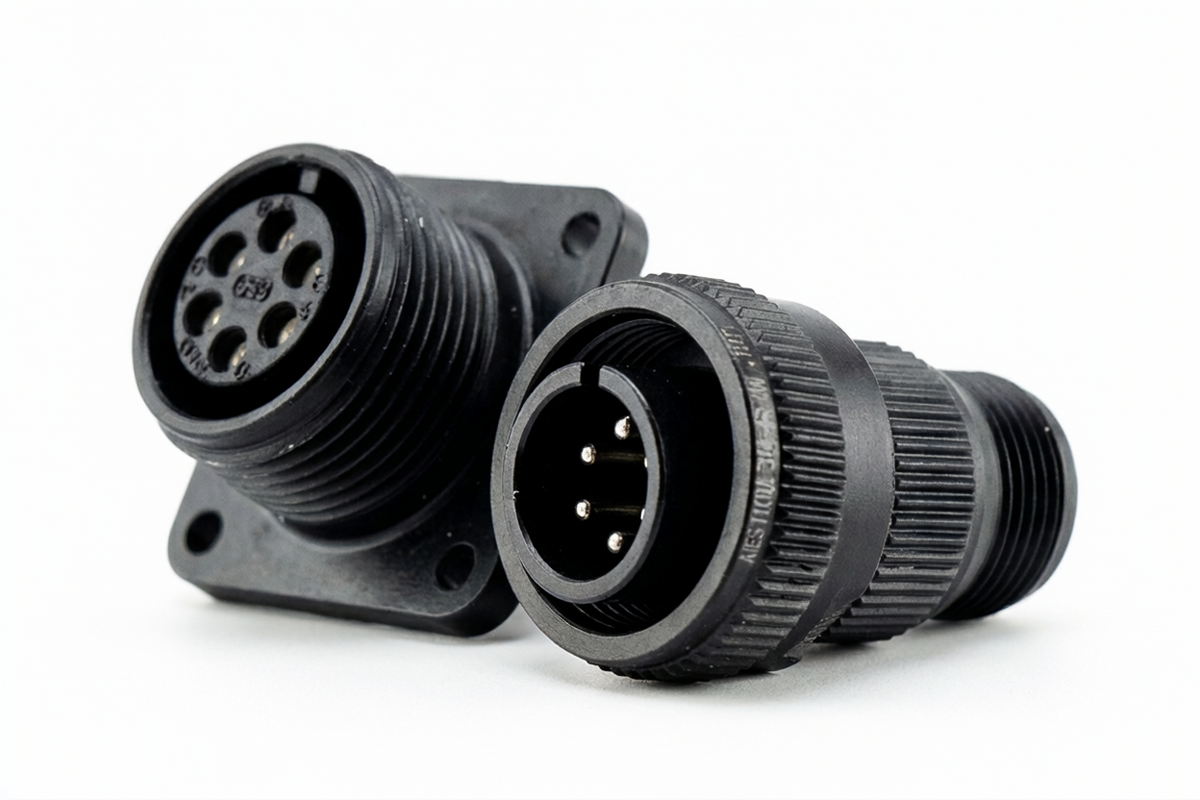
Amerline offers threaded coupling connector solutions built for the demands of military and industrial applications, from our AEC 5015 and AEC 22992 series to fully custom configurations. With 40+ years of experience supporting defense and industrial connector needs, Amerline helps engineers and procurement teams identify the right solution for their application, whether that's an off-the-shelf connector or a modified design that meets specific environmental, mechanical, or cycle life requirements.
What Is Threaded Coupling?
Threaded coupling is a connector-locking method that uses mating screw threads on the plug and receptacle shells to join two connector halves. Rotating a coupling nut draws the shells into full metal-to-metal contact, creating a secure, vibration-resistant connection. It's the same mechanism behind Amerline's AEC 5015 Commercial Series connectors and other MIL-DTL-5015-style designs.
Key Takeaways
- Threaded coupling locks two connector halves together using mating screw threads and a rotating coupling nut.
- It requires multiple full rotations to mate, unlike the quarter- or half-turn needed for bayonet or reverse bayonet coupling.
- Threaded coupling is standard on MIL-DTL-5015-style connectors, including Amerline's AEC 5015 Commercial Series, which is a drop-in commercial equivalent.
- Correct mating relies on proper hand-tight engagement; over-torquing can strip threads, while under-tightening risks loosening under vibration.
How Threaded Coupling Works
Mating starts with alignment: the plug and receptacle are brought together, and the first thread is engaged by hand. From there, the coupling nut is turned clockwise, drawing the two halves closer with each rotation until they reach metal-to-metal bottoming.
Getting to that point typically takes several full turns. It's a different process from the quarter-turn engagement of a bayonet or quick-disconnect coupling design, and one that asks the person making the connection to stay attentive through the whole motion rather than relying on a single click or stop.
|
Threaded Design |
Bayonet Design |
|
|
Mating action |
Multiple full rotations |
Partial turn (quarter- to half-turn) |
|
Confirmation method |
Torque feel / metal-to-metal bottoming |
Audible or tactile click |
|
Vibration resistance |
High once fully seated |
High, with a self-confirming lock |
|
Typical use case |
Long-service, low-disconnect installations |
Frequent connect/disconnect cycles |
What Happens If a Threaded Coupling Is Over- or Under-Tightened?
Too much torque risks stripping or galling the threads; too little leaves a threaded connection vulnerable to loosening and a compromised environmental seal once vibration sets in. The safer approach is hand-tight engagement followed by a confirmation check, rather than tightening by feel alone.
|
Step |
Action |
What to Check |
|
1 |
Align keyway/insert |
Halves line up without forcing |
|
2 |
Hand-start the thread |
Nut turns freely before tool torque is applied |
|
3 |
Rotate coupling nut clockwise |
Steady resistance, no cross-threading |
|
4 |
Continue to full engagement |
Metal-to-metal bottoming or confirmation mark reached |
|
5 |
Final check |
No play or rotation remains |
The Difference Between Threaded Coupling & Bayonet Coupling
Which Coupling Type Mates Faster?
Bayonet and reverse bayonet couplings mate with a partial turn — often a quarter- to half-turn — while threaded coupling requires several full rotations to reach the same secure connection. The trade-off is straightforward: mating speed against the holding strength of a fully threaded, metal-to-metal joint.
Which Coupling Type Is Better for High-Vibration Industrial Applications?
Both styles hold up in high-vibration environments; where they differ is how the connection confirms itself. Threaded coupling relies on torque feel and visual cues, while bayonet designs are often built to click or stop distinctly once locked. Neither is the better choice across the board. The right fit depends on how often the connection will be made and broken, and how quickly a technician needs to confirm it's secure.
|
Threaded Coupling |
Bayonet Coupling |
Reverse Bayonet Coupling |
|
|
Mating action |
Multiple full rotations |
Partial turn |
Partial turn |
|
Confirmation method |
Torque feel/bottoming |
Audible/tactile click |
Audible/tactile click |
|
Typical AEC series |
AEC 5015, AEC 22992 |
AEC 26482 |
AEC 95234 |
Threaded Coupling in Amerline's AEC Connector Line
Amerline builds threaded coupling into several AEC series connectors for applications. Beyond the AEC 5015 Commercial Series, the AEC 22992 commercial series connectors offer another threaded-style option engineered to the same quality standard. For military and industrial applications that call for faster, more frequent disconnects, Amerline's bayonet and reverse bayonet series deliver comparable ruggedness with a quicker mating cycle.
Frequently Asked Questions About Threaded Coupling
What is a threaded coupling connector?
A threaded coupling connector locks two connector halves together using matching screw threads on the plug and receptacle. Rotating a coupling nut draws the two halves into a secure, vibration-resistant connection.
How does a threaded coupling work?
The plug and receptacle threads engage as the coupling nut is turned. Continued rotation seats the connector fully, typically confirmed by metal-to-metal bottoming or a visual mating indicator.
What is the difference between threaded coupling and bayonet coupling?
Threaded coupling requires multiple full rotations to mate; bayonet and reverse bayonet coupling require only a partial turn. Both provide secure, vibration-resistant connections, but they differ in mating speed and confirmation method.
Is threaded coupling used in military-spec connectors?
Yes, threaded coupling is standard on MIL-DTL-5015-style circular connectors, including Amerline's AEC 5015 Commercial Series, used across military, aerospace, and industrial applications.
Can a threaded coupling connector loosen over time?
It can, if it isn't fully seated during mating or is exposed to sustained vibration without a locking feature. Verifying full engagement at installation reduces this risk.