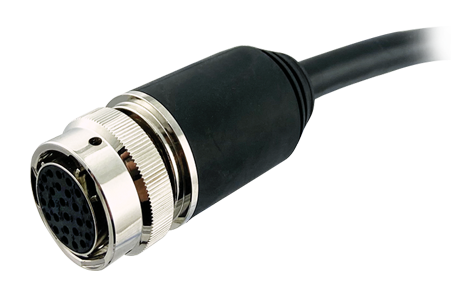
Amerline provides connector overmolding solutions for applications where strain relief, sealing, and vibration resistance are non-negotiable. Overmolding can be applied to standard and custom connector solutions to eliminate weak points at the cable entry, delivering a durable assembly that holds up in the field. For applications that need protection inside and out, overmolding can be paired with potting for comprehensive coverage.
What Is Connector Overmolding?
Key Takeaways
- Connector overmolding bonds a protective polymer directly over the cable-to-connector junction on circular connectors or other styles, creating a sealed mechanical assembly instead of separate hardware.
- Overmolding materials fall into two families, thermoplastics and elastomers, and Amerline's standard hot melt encapsulant builds on the strengths of both.
- Mold tooling decisions, such as building new steel or aluminum tooling versus adapting an existing mold, have the biggest impact on upfront cost and lead time.
- Overmolded assemblies deliver 360-degree strain relief, higher ingress protection, and greater vibration resistance than standard cable assemblies, making them well suited to harsh environments.
- For applications that need both internal and external protection, Amerline pairs potting compound with overmolding to deliver comprehensive protection from a single source.
Connector overmolding is the process of encapsulating the backshell area of a connector-to-cable junction in a durable, injection-molded polymer, forming a single sealed assembly. Amerline's connector overmolding service bonds the material directly to the connector body and cable jacket using a low-pressure injection molding process, eliminating the mechanical weak point at the cable entry. The result is strain relief and environmental protection built into the assembly, guarding against moisture, vibration, dust, and abrasion in the field.
How Does Connector Overmolding Work?
Standard cable assemblies protect the connector-to-cable junction with separate hardware like a backshell, a clamp, or sometimes heat shrink tubing. Each piece does its job individually, but none of them bond directly to both the connector and the cable, which leaves small gaps and points of movement at the junction. Over time, vibration, repeated flexing, or temperature swings can work those gaps open, and moisture, dust, or chemicals find their way in.
Connector overmolding replaces separate hardware with a single molded layer. The cable assembly is positioned in a mold, and a heated thermoplastic or elastomer is injected around the connector's backshell and the adjoining section of cable jacket. As the material cools, it bonds to both surfaces, forming one continuous, sealed piece rather than a connector, a cable, and hardware.
Because the polymer is fused to the assembly rather than clamped around it, the junction can flex and vibrate without opening a path for contamination. It's the core mechanical advantage overmolding offers over backshell-and-clamp designs.
A Step-By-Step Breakdown of the Molding Process
The overmolding process follows a consistent sequence:
- Position the cable assembly in a mold cavity sized to the connector and cable geometry.
- Inject heated thermoplastic or elastomer material into the cavity at low pressure, fully encapsulating the backshell area.
- Cool the material until it solidifies and bonds to both the connector body and the cable jacket.
- Once the material has fully cured, release the assembly from the mold, leaving a single sealed unit.
- Inspect the finished overmold for flash, dimensional accuracy, and seal integrity prior to testing.
Exact parameters vary by manufacturer and application. There's a preference for low-pressure injection versus high-pressure molding, since connectors contain delicate internal contacts and wire terminations that can be damaged or displaced by higher injection forces. Low-pressure molding fills the cavity gently enough to fully encapsulate the backshell area without disturbing what's inside it.
What Materials Are Used in Connector Overmolding?
Connector overmolding materials generally fall into two families: thermoplastics and elastomers. Both are melted and injected under heat, then cooled into a solid layer bonded around the connector; what differs is how each behaves once it's cured.
Understanding Thermoplastics and Elastomers in Overmolding
|
Material Family |
Key Properties |
Common Applications |
Trade-offs |
|
Thermoplastics |
Rigid to semi-rigid; high impact and chemical resistance; generally cost-effective |
High-cycle industrial applications; commercial and consumer electronics |
Less flexible; can become brittle or crack in extreme cold or high-flex applications |
|
Elastomers |
Flexible, abrasion- and UV-resistant, wide temperature range, soft-touch feel |
Industrial robotics and portable equipment; military field equipment and outdoor sensors |
Generally costs more than rigid thermoplastics; softer formulations can have lower tear resistance |
Amerline's standard overmolding material builds on what thermoplastics do well. Its hot melt encapsulant is a black, UV-stable thermoplastic compound engineered specifically for connector overmolding. It combines the impact and chemical resistance and cost efficiency inherent to thermoplastics with a formulation that bonds tightly to the connector body and holds up across environments.
When a project calls for something outside Amerline's standard formulation — a different flex profile, temperature rating, or color — Amerline works with customers to adjust the compound to the application.
What Tooling Is Used in Connector Overmolding?
Tooling is usually where cost and lead time diverge most between suppliers, making it the biggest variable in most connector overmolding projects. There are two paths: creating a new mold, or adapting an existing one.
New molds are built in either steel or aluminum, and the choice comes down to volume and durability. Steel tooling costs more upfront but holds up over more injection cycles, making it the better fit for high-volume production. Aluminum overmold tooling is less expensive and faster to produce, which suits lower-volume runs or prototypes, though it wears faster over time.
Before committing to a new mold, Amerline's team evaluates whether an existing mold can be adapted with inserts to fit a similar connector geometry. Evaluating reuse options before cutting new steel is one of the most effective ways to keep a project on budget and on schedule.
Benefits of Overmolded Cable Assemblies
Overmolding adds several advantages over a standard cable assembly, most of which trace back to eliminating the mechanical weak point at the cable entry. The table below breaks down what that translates to in the field.
|
Benefit |
What It Delivers |
|
Sealed cable entry |
Bonded polymer closes the gaps a gasket or clamp would otherwise leave at the junction. |
|
360-degree strain relief |
Strain relief is molded into the assembly itself, rather than depending on an external clamp. |
|
High ingress protection |
Factory-sealed assemblies can reach IP67+ ratings, beyond what a field-assembled backshell typically achieves. |
|
Vibration resistance |
The polymer absorbs mechanical stress instead of transferring it to the junction. |
|
Fewer failure points |
The cable-to-connector junction becomes a continuous bond, removing the most common weak point in standard assemblies. |
|
Design flexibility |
Color, shape, logo, and cable-exit angle can all be built in during molding. |
|
Lower long-term maintenance |
A sealed unit degrades more slowly than an assembly with separate mechanical parts, reducing inspection and repair needs. |
Where Are Overmolded Assemblies Commonly Found?
Connector overmolding is valuable when a cable-to-connector junction has to survive mechanical stress, moisture, or contamination in service. This covers a wide range of industries, though a few rely on it more heavily than others:
- Military and defense:tactical vehicles, ground systems, communications equipment, and ordnance connections that must hold up under constant vibration and exposure to the elements.
- Industrial automation: robotics, machinery, and factory-floor equipment exposed to oils, coolants, and abrasion.
- Automotive: connectors subjected to thermal cycling, road vibration, and under-hood conditions.
- Medical: equipment connectors that need to withstand repeated cleaning and meet biocompatibility requirements.
How Do Overmolding and Potting Work Together?
Potting and overmolding both add a layer of protection to a connector assembly, but they solve different problems on different parts of the assembly. Understanding the distinction and when to combine them makes clear what each process protects against.
Potting is an internal process: a resin is poured or injected into the connector or enclosure cavity, filling the space around the internal wiring and terminations to seal out moisture, dust, and contaminants from the inside. Overmolding works from the outside, molding a polymer layer over the cable-to-connector junction to reinforce it against bending, pulling, vibration, and impact.
In demanding environments, the two are often used together rather than as alternatives. Potting protects the integrity of the electrical terminations by sealing out contaminants from within the connector. Overmolding reinforces the cable interface against the mechanical stress it faces from outside.
Combining both closes the gaps that either process leaves on its own. Amerline offers both overmolding and potting services, giving customers a single source for the comprehensive protection that demanding assemblies call for.
Frequently Asked Questions About Overmolded Cable Assemblies
What is connector overmolding?
Connector overmolding is the process of injecting a polymer material around the backshell area of a connector and cable assembly to form a sealed, one-piece unit. It eliminates the cable-to-connector junction as a failure point by bonding the material directly to both the connector body and the cable jacket. The result is a protected assembly with built-in strain relief and environmental sealing.
What is the difference between overmolding and a backshell?
A backshell is a separate mechanical housing that attaches to the rear of a connector to provide strain relief and cable management. Overmolding replaces or supplements the backshell by injecting polymer directly over the junction, forming a continuous bond. Unlike a backshell, an overmold has no loose parts and cannot loosen or separate under vibration. Backshells are easier to field-service; overmolded assemblies are more durable in harsh, high-cycle environments.
What materials are used for connector overmolding?
Overmolding materials generally fall into two families: thermoplastics, which range from rigid to semi-rigid and resist impact and chemical exposure, and elastomers, which stay flexible after curing and absorb vibration and movement. Amerline's standard material is its own hot melt thermoplastic encapsulant: a black, UV-stable compound that builds on the inherent properties of thermoplastics, engineered specifically for connector overmolding rather than adapted from a general-purpose resin.
Is connector overmolding expensive?
Overmolding adds cost over a standard cable assembly, primarily in tooling. Those tooling costs can be reduced by modifying or reusing existing molds for similar connector geometries, rather than creating new tooling from scratch. Over the life of the application, overmolded assemblies tend to lower total cost of ownership because they last longer and require fewer repairs or replacements. Domestically produced overmolded assemblies also avoid overseas tariffs and import delays.
How long does it take to produce overmolded assemblies?
Production time for overmolded assemblies is longer than for standard cable assemblies due to tooling, mold setup, and the injection molding cycle. Lead time depends on whether new tooling must be made or an existing mold can be adapted. Working with a domestic manufacturer shortens lead time compared to offshore production and allows for faster communication during development.
Can overmolded connectors be customized?
Yes, overmolded connector assemblies offer significant customization options, including material formulation, color, shape, and the angle of the cable exit. Custom colors can be used for color-coding or brand identification, and mold geometry can be tailored to the specific installation angle, strain relief direction, or connector series being used.